
Training 11 min read
Running Pace Explained: min/km, km/h, Miles and Race Pace Charts
What 5:30 per km really means, how to convert pace to km/h or minutes per mile, and the exact pace you need for a 25-minute 5K or a 4-hour marathon. Formulas, worked examples and charts.
Published by BEON.RUN · · Updated
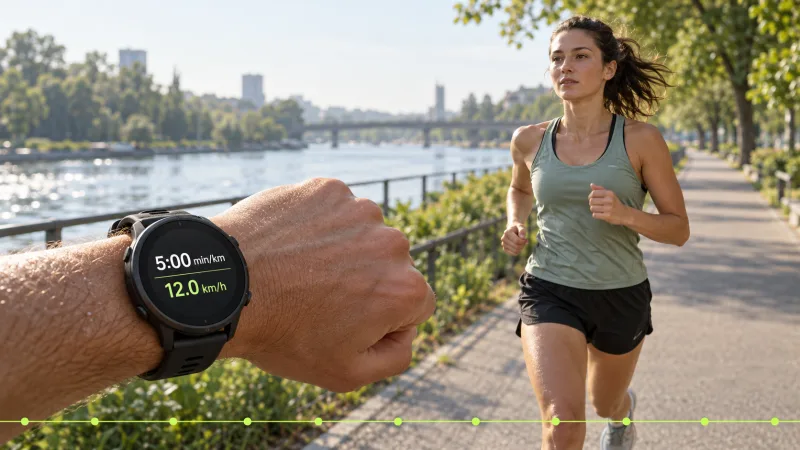
Pace is the number that runs your running life. You talk about it with training partners, you check it on your watch, and on race day it decides whether you break 25 minutes for 5K or run out of steam two kilometers from the finish.
The tricky part is that pace works "backwards" compared with the speed you know from driving. The smaller the number, the faster you go. This guide gives you the formulas, step-by-step examples and exact pace charts for 5K, 10K, half marathon and marathon, in kilometers and miles. Every value has been calculated, so you can bookmark it and use it before your next race.
What min/km (and min/mile) actually means
Pace tells you how long one kilometer takes. 5:30 min/km means 5 minutes and 30 seconds for every kilometer. If you train in miles, 8:51 min/mile is the same effort expressed per mile.
Runners prefer pace over speed because it makes mental math easy. At 6:00 per km a 10K takes an hour, at 5:00 per km it takes 50 minutes. Try doing that in your head with km/h.
Three rules to remember:
- lower pace = faster running (4:30 is faster than 5:30),
- seconds go up to 60, not 100 (5:30 is five and a half minutes, not 5.3),
- average pace covers the whole run, current pace only the last few seconds.
How to convert pace to km/h and back
Every conversion comes down to one number: 60, the minutes in an hour.
Pace to speed: km/h = 60 / pace in minutes.
Speed to pace: pace in minutes = 60 / km/h.
The only trap is the seconds. Before dividing, turn them into a fraction of a minute (30 s = 0.5, 15 s = 0.25, 45 s = 0.75). After dividing, multiply the decimal part by 60.
Worked examples
- 5:30 per km to km/h. 5:30 is 5.5 minutes. 60 / 5.5 = 10.91 km/h.
- 12 km/h to pace. 60 / 12 = 5 minutes, so 5:00 per km.
- 10.5 km/h to pace. 60 / 10.5 = 5.714 minutes. 0.714 × 60 = 43 s, so 5:43 per km.
- Pace from time and distance. 10 km in 52:30 is 52.5 minutes / 10 = 5.25 minutes, so 5:15 per km.
- Finish time from pace. A half marathon (21.0975 km) at 6:10 per km is 6.1667 × 21.0975 = 130.1 minutes, so 2:10:06.
Quick pace and speed chart
Every 15 seconds from 3:00 to 8:00 per km, with the matching pace per mile and the speed in km/h and mph.
| Pace (min/km) | Speed (km/h) | Pace (min/mile) | Speed (mph) |
|---|---|---|---|
| 3:00 | 20.00 | 4:50 | 12.43 |
| 3:15 | 18.46 | 5:14 | 11.47 |
| 3:30 | 17.14 | 5:38 | 10.65 |
| 3:45 | 16.00 | 6:02 | 9.94 |
| 4:00 | 15.00 | 6:26 | 9.32 |
| 4:15 | 14.12 | 6:50 | 8.77 |
| 4:30 | 13.33 | 7:15 | 8.28 |
| 4:45 | 12.63 | 7:39 | 7.85 |
| 5:00 | 12.00 | 8:03 | 7.46 |
| 5:15 | 11.43 | 8:27 | 7.10 |
| 5:30 | 10.91 | 8:51 | 6.78 |
| 5:45 | 10.43 | 9:15 | 6.48 |
| 6:00 | 10.00 | 9:39 | 6.21 |
| 6:15 | 9.60 | 10:04 | 5.97 |
| 6:30 | 9.23 | 10:28 | 5.74 |
| 6:45 | 8.89 | 10:52 | 5.52 |
| 7:00 | 8.57 | 11:16 | 5.33 |
| 7:15 | 8.28 | 11:40 | 5.14 |
| 7:30 | 8.00 | 12:04 | 4.97 |
| 7:45 | 7.74 | 12:28 | 4.81 |
| 8:00 | 7.50 | 12:52 | 4.66 |
On a treadmill you often need the other direction: 10 km/h is 6:00 per km, 11 km/h is 5:27, 13 km/h is 4:37 and 14 km/h is 4:17 per km.
Converting min/km to min/mile
One mile is 1.609344 km. So:
- min/mile = min/km × 1.609
- min/km = min/mile / 1.609
Example: 5:00 per km is 300 s × 1.609 = 483 s, which is 8:03 per mile. Going the other way, 9:00 per mile is 540 s / 1.609 = 336 s, or 5:36 per km.
| Pace (min/mile) | Pace (min/km) | Speed (mph) | Speed (km/h) |
|---|---|---|---|
| 5:00 | 3:06 | 12.00 | 19.31 |
| 5:15 | 3:16 | 11.43 | 18.39 |
| 5:30 | 3:25 | 10.91 | 17.56 |
| 5:45 | 3:34 | 10.43 | 16.79 |
| 6:00 | 3:44 | 10.00 | 16.09 |
| 6:15 | 3:53 | 9.60 | 15.45 |
| 6:30 | 4:02 | 9.23 | 14.86 |
| 6:45 | 4:12 | 8.89 | 14.31 |
| 7:00 | 4:21 | 8.57 | 13.79 |
| 7:15 | 4:30 | 8.28 | 13.32 |
| 7:30 | 4:40 | 8.00 | 12.87 |
| 7:45 | 4:49 | 7.74 | 12.46 |
| 8:00 | 4:58 | 7.50 | 12.07 |
| 8:15 | 5:08 | 7.27 | 11.70 |
| 8:30 | 5:17 | 7.06 | 11.36 |
| 8:45 | 5:26 | 6.86 | 11.04 |
| 9:00 | 5:36 | 6.67 | 10.73 |
| 9:15 | 5:45 | 6.49 | 10.44 |
| 9:30 | 5:54 | 6.32 | 10.16 |
| 9:45 | 6:04 | 6.15 | 9.90 |
| 10:00 | 6:13 | 6.00 | 9.66 |
| 10:15 | 6:22 | 5.85 | 9.42 |
| 10:30 | 6:31 | 5.71 | 9.20 |
| 10:45 | 6:41 | 5.58 | 8.98 |
| 11:00 | 6:50 | 5.45 | 8.78 |
| 11:15 | 6:59 | 5.33 | 8.58 |
| 11:30 | 7:09 | 5.22 | 8.40 |
| 11:45 | 7:18 | 5.11 | 8.22 |
| 12:00 | 7:27 | 5.00 | 8.05 |
| 12:15 | 7:37 | 4.90 | 7.88 |
| 12:30 | 7:46 | 4.80 | 7.72 |
| 12:45 | 7:55 | 4.71 | 7.57 |
| 13:00 | 8:05 | 4.62 | 7.43 |
Walking and run-walk pace (min/mile to min/km)
Slower paces matter too, for walkers, hikers and run-walk intervals. A 15-minute mile is a brisk walk, a 20-minute mile a relaxed one.
| Pace (min/mile) | Pace (min/km) | Speed (mph) | Speed (km/h) |
|---|---|---|---|
| 14:00 | 8:42 | 4.29 | 6.90 |
| 15:00 | 9:19 | 4.00 | 6.44 |
| 16:00 | 9:57 | 3.75 | 6.04 |
| 17:00 | 10:34 | 3.53 | 5.68 |
| 18:00 | 11:11 | 3.33 | 5.36 |
| 19:00 | 11:48 | 3.16 | 5.08 |
| 20:00 | 12:26 | 3.00 | 4.83 |
| 21:00 | 13:03 | 2.86 | 4.60 |
"8.30 pace": decimal or minutes and seconds?
Many people type pace with a dot, as in "8.30 min mile" or "7.15 pace". In almost every case that means 8 minutes 30 seconds and 7 minutes 15 seconds, not 8.3 or 7.15 decimal minutes. The difference is real: 8:30 per mile is 5:17 per km, while 8.30 decimal minutes (8:18) would be 5:09 per km. If a number after the dot is 60 or more, it can only be a decimal.
Common conversions at a glance
- 4:00 per km = 6:26 per mile = 15 km/h
- 5:00 per km = 8:03 per mile = 12 km/h = 7.46 mph
- 6:00 per km = 9:39 per mile = 10 km/h
- 7:00 per mile = 4:21 per km = 13.79 km/h
- 8:30 per mile = 5:17 per km = 11.36 km/h
- 10:00 per mile = 6:13 per km = 9.66 km/h
- 19:00 per mile (walking) = 11:48 per km = 5.08 km/h
Pace charts for 5K, 10K, half marathon and marathon
All paces are rounded to the nearest second. In a race, the distance on your watch usually ends up a little longer than the official course, because nobody runs the measured racing line perfectly. For an ambitious goal, plan 2-3 seconds per km faster than the chart.
5K pace chart
| 5K time | min/km | km/h | min/mile |
|---|---|---|---|
| 20:00 | 4:00 | 15.00 | 6:26 |
| 22:30 | 4:30 | 13.33 | 7:15 |
| 25:00 | 5:00 | 12.00 | 8:03 |
| 27:30 | 5:30 | 10.91 | 8:51 |
| 30:00 | 6:00 | 10.00 | 9:39 |
| 32:30 | 6:30 | 9.23 | 10:28 |
| 35:00 | 7:00 | 8.57 | 11:16 |
| 37:30 | 7:30 | 8.00 | 12:04 |
| 40:00 | 8:00 | 7.50 | 12:52 |
If 5K is still a goal rather than a warm-up, start with our 8-week beginner plan from zero to 5K.
10K pace chart
| 10K time | min/km | km/h | min/mile | 5K split |
|---|---|---|---|---|
| 40:00 | 4:00 | 15.00 | 6:26 | 20:00 |
| 45:00 | 4:30 | 13.33 | 7:15 | 22:30 |
| 50:00 | 5:00 | 12.00 | 8:03 | 25:00 |
| 55:00 | 5:30 | 10.91 | 8:51 | 27:30 |
| 60:00 | 6:00 | 10.00 | 9:39 | 30:00 |
| 65:00 | 6:30 | 9.23 | 10:28 | 32:30 |
| 70:00 | 7:00 | 8.57 | 11:16 | 35:00 |
| 75:00 | 7:30 | 8.00 | 12:04 | 37:30 |
Half marathon pace chart (21.0975 km / 13.1 miles)
| Finish time | min/km | km/h | min/mile | 10K split |
|---|---|---|---|---|
| 1:30:00 | 4:16 | 14.06 | 6:52 | 42:40 |
| 1:40:00 | 4:44 | 12.66 | 7:38 | 47:24 |
| 1:45:00 | 4:59 | 12.06 | 8:01 | 49:46 |
| 1:50:00 | 5:13 | 11.51 | 8:23 | 52:08 |
| 2:00:00 | 5:41 | 10.55 | 9:09 | 56:53 |
| 2:15:00 | 6:24 | 9.38 | 10:18 | 1:03:59 |
| 2:30:00 | 7:07 | 8.44 | 11:27 | 1:11:06 |
| 2:45:00 | 7:49 | 7.67 | 12:35 | 1:18:12 |
Marathon pace chart (42.195 km / 26.2 miles)
| Finish time | min/km | km/h | min/mile | Halfway |
|---|---|---|---|---|
| 3:00:00 | 4:16 | 14.06 | 6:52 | 1:30:00 |
| 3:15:00 | 4:37 | 12.98 | 7:26 | 1:37:30 |
| 3:30:00 | 4:59 | 12.06 | 8:01 | 1:45:00 |
| 3:45:00 | 5:20 | 11.25 | 8:35 | 1:52:30 |
| 4:00:00 | 5:41 | 10.55 | 9:09 | 2:00:00 |
| 4:15:00 | 6:03 | 9.93 | 9:44 | 2:07:30 |
| 4:30:00 | 6:24 | 9.38 | 10:18 | 2:15:00 |
| 4:45:00 | 6:45 | 8.88 | 10:52 | 2:22:30 |
| 5:00:00 | 7:07 | 8.44 | 11:27 | 2:30:00 |
| 5:15:00 | 7:28 | 8.04 | 12:01 | 2:37:30 |
| 5:30:00 | 7:49 | 7.67 | 12:35 | 2:45:00 |
Notice that a 1:30 half and a 3:00 marathon share the same pace, 4:16 per km. The difference is that you have to hold it twice as long. That is why most runners' marathon pace is clearly slower than their half marathon pace.
Other distances: 1 mile, 8K, 15K and 10 miles
Not every race is a 5K or a marathon. Many popular road races are run over 8K, 15K or 10 miles, and the mile is a classic test on the track. Finish times at a steady pace:
| Pace (min/km) | Pace (min/mile) | 1 mile | 8K | 15K | 10 miles |
|---|---|---|---|---|---|
| 4:00 | 6:26 | 6:26 | 32:00 | 1:00:00 | 1:04:22 |
| 4:30 | 7:15 | 7:15 | 36:00 | 1:07:30 | 1:12:25 |
| 5:00 | 8:03 | 8:03 | 40:00 | 1:15:00 | 1:20:28 |
| 5:30 | 8:51 | 8:51 | 44:00 | 1:22:30 | 1:28:31 |
| 6:00 | 9:39 | 9:39 | 48:00 | 1:30:00 | 1:36:34 |
| 6:30 | 10:28 | 10:28 | 52:00 | 1:37:30 | 1:44:36 |
| 7:00 | 11:16 | 11:16 | 56:00 | 1:45:00 | 1:52:39 |
| 7:30 | 12:04 | 12:04 | 1:00:00 | 1:52:30 | 2:00:42 |
| 8:00 | 12:52 | 12:52 | 1:04:00 | 2:00:00 | 2:08:45 |
To go the other way, divide the finish time by the distance. A 25-minute 8K is 1,500 s / 8 = 188 s, so 3:08 per km or 5:02 per mile.
Easy pace, tempo pace and race pace
Not every run should be fast. Most of your weekly kilometers are easy, and hard sessions are the seasoning. The simplest way to tell intensities apart is the talk test.
| Type of pace | Talk test | What it is for |
|---|---|---|
| Easy | You can speak in full sentences | Aerobic base, recovery, long runs |
| Tempo (threshold) | A few words at a time, then breathe | Holding a strong pace for longer |
| 5K-10K race pace | Single words only | Intervals, shorter races |
A few general rules of thumb that work for many recreational runners:
- easy pace is often 1-2 minutes per km slower than your current 5K race pace,
- tempo pace usually sits between your 10K pace and your half marathon pace,
- marathon pace is slower than half marathon pace, for many amateurs by somewhere between 10 and 30+ seconds per km.
These are ranges, not prescriptions. Heat, wind, hills and fatigue all shift pace at the same effort. If you have a health condition, are coming back from a break or are just starting, agree on intensity with a doctor or a coach.
How to plan race pace (and why negative splits work)
The most common race-day mistake is going out too fast. Adrenaline, the crowd and fresh legs make the first kilometer feel easy. Every 10-15 seconds per km you "bank" early is often paid back with interest at the end.
The safer strategy is even pacing or a negative split: the second half faster than the first.
Negative split examples
- 10K in 50:00: first 5 km in 25:30 (5:06 per km), second in 24:30 (4:54 per km).
- Half marathon in 2:00:00: first 10 km at 5:45 per km (57:30), the remaining 11.0975 km at 5:38 per km (about 62:30).
- Marathon in 4:00:00: first half in about 2:01:00 (5:44 per km), second in about 1:59:00 (5:38 per km).
The differences are small, a few seconds per km. That is the point: the start should be controlled, not slow.
A pacing plan in four steps
- Pick a realistic goal based on recent races or training, not on hope.
- Read the pace from the chart and write down your 5K, 10K and halfway splits.
- Run the first 2-3 km 3-5 seconds per km slower, then settle into goal pace.
- In the last quarter of the race, speed up if you have it in you.
For everything else about the big day, from the night before to the finish, read our guide to your first marathon race day.
Why current pace jumps and average pace is reliable
Current pace is calculated from the last few seconds of movement. In 5 seconds at 5:00 per km you cover just under 17 meters. Phone and watch GPS is typically off by a few meters.
If the position drifts 3 meters one way or the other, the same steady 5:00 per km can show up as 4:14 or 6:06. You run evenly, the numbers jump. Tall buildings, trees, tunnels and tight corners make it worse. Read more in why your watch and phone show a different distance.
Average pace, calculated as time divided by distance, is far steadier. A few meters of error over 5 km is a fraction of a percent. In a race, look at your lap or per-km average rather than current pace.
Pace for spectators: when will the runner reach you?
Pace is not only for the runner. If you are following a race live and want to catch your runner at the 32 km mark, you need one simple formula:
time to your spot = distance to your spot × pace
Example: the runner is at 27.4 km, you are standing at 32 km, and their average pace is 5:50 per km. The distance to you is 4.6 km. 4.6 × 5:50 (350 s) = 1,610 s, so about 26 minutes 50 seconds.
Add a few minutes of buffer. Pace usually drops a little in the second half of a marathon, and hills and water stations cost time too. Better to wait three extra minutes than to see only their back.
That is why, when you watch a run live, current distance and average pace matter most. With BEON.RUN a spectator gets one link and sees the position on the map, the route so far, distance, time and pace in any browser, without an account and without installing an app, plus live video if the runner turns the camera on. Our guide on how to track a runner live during a marathon shows it in practice, and there are more ideas in ways to cheer from a distance.
Key takeaways
- Pace is time per kilometer (or mile): the smaller the number, the faster.
- km/h = 60 / pace in minutes, pace = 60 / km/h. Turn seconds into fractions of a minute first.
- min/mile = min/km × 1.609.
- A 25-minute 5K is 5:00 per km, a 2-hour half is 5:41, and so is a 4-hour marathon.
- Run most sessions easy and check yourself with the talk test.
- Start races controlled and speed up in the second half.
- Trust average pace, not current pace.
Want your people to see your pace and route live at your next race? Create a free account and send them the link before the start.
Frequently asked questions
How do I convert min/km to km/h?
Divide 60 by your pace in decimal minutes. Convert the seconds first: 5:30 per km is 5.5 minutes, so 60 / 5.5 = 10.91 km/h. To go back, divide 60 by the speed: 12 km/h gives 60 / 12 = 5 minutes, so 5:00 per km. Multiply any decimal part by 60 to turn it back into seconds.
How do I convert pace per km to pace per mile?
Multiply the pace per km by 1.609 (one mile is 1.609344 km). 5:00 per km is 300 seconds × 1.609 = 483 seconds, or 8:03 per mile. To go from miles to kilometers, divide by 1.609: 9:00 per mile is about 5:36 per km, and 10:00 per mile is about 6:13 per km.
What is 5 minutes per km in miles?
5:00 per km is 8:03 per mile. That is a speed of 12 km/h or 7.46 mph, and a 25:00 5K or a 50:00 10K. For a quick estimate, add 3 minutes and 3 seconds to a 5-minute km pace; for other paces multiply the seconds per km by 1.609.
What is a 19-minute mile in km?
A 19:00 mile is 11:48 per km, a walking speed of about 5.1 km/h (3.16 mph). Brisk walking is usually 14-16 minutes per mile (8:42-9:57 per km); 19-20 minutes per mile is a relaxed walk.
What pace do I need for a 4-hour marathon?
A 4:00:00 marathon is an average of 5:41 per km (5:41.3 to be exact) or 9:09 per mile, about 10.55 km/h. You should pass halfway in about 2:00:00. Because corners and weaving add distance, many runners aim for 5:38-5:40 per km on the watch to build a small buffer.
Why does my current pace keep jumping?
Current pace is calculated from the last few seconds of movement, and a GPS position is off by a few meters. Over a 15-20 m stretch, that error can swing the result by a minute per km. Average pace from total distance and time is much steadier, because single errors are spread over a long distance.
What is a negative split?
A negative split means running the second half faster than the first. Example: a 50-minute 10K run as 25:30 and 24:30. It protects you from going out too fast, which usually ends with a big slowdown late in the race. It is a good default strategy, especially for the half and full marathon.
Let your people follow your route live
Video, GPS map and pace in one link. Viewers need no app and no account.