Training 9 min read
Brisk Walking Plan for Beginners: 8 Weeks from 20 to 60 Minutes
How fast brisk walking really is, how many minutes a week are worth collecting, and an 8-week plan that takes you from 20-minute walks to one-hour brisk walks with intervals.
Published by BEON.RUN ·
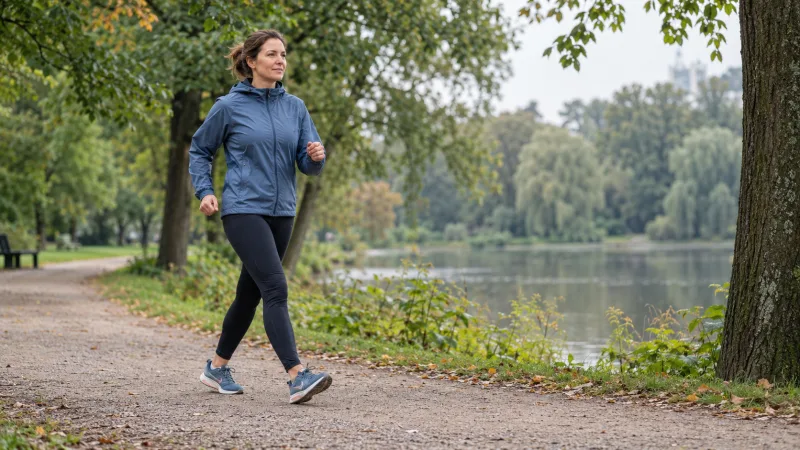
Brisk walking is the most underrated workout there is. No gym membership, no special gear, no fitness required to start. Comfortable shoes, 20 minutes and a sidewalk, park or trail near home are enough.
That is a mistake. A well-planned walking routine builds fitness, makes movement a habit and is a great first step for anyone who finds running too much right now. The key is the difference between a stroll and a workout: pace, consistency and gradually adding time.
Below you get concrete answers: how fast brisk walking is, how much to walk per day and per week, an 8-week walking plan with a table, technique, shoes, how to move from walking to running, and a few ways to stay motivated past week three.
Before you start: a quick health note
Walking is one of the safest forms of exercise, but that does not mean everyone can walk briskly for an hour on day one. If you have a heart condition, high blood pressure, diabetes, joint or back problems, are pregnant, or have been inactive for a long time, talk to your doctor first.
How fast is brisk walking?
A stroll is the pace where you window-shop and chat without effort. Brisk walking is clearly more: your breathing picks up and after a few minutes you feel warm, but you never need to jog.
The most reliable gauge is the talk test, the same one beginner runners use:
- You could sing: that is a stroll, speed up.
- You can speak in full sentences, but singing would be hard: that is brisk walking, exactly right.
- You can only get out a few words: that is very brisk walking, good for short intervals, not for a whole session.
If you prefer numbers, brisk walking for many adults is typically about 5-6.5 km/h (roughly 3-4 mph), or around 9-12 min/km (about 15-19 min/mile). Treat these as a typical range, not a test to pass.
| Type of walk | Typical pace | Typical speed | Talk test |
|---|---|---|---|
| Easy stroll | slower than 12 min/km | under 5 km/h (about 3 mph) | you could sing |
| Brisk walk | about 9-12 min/km | about 5-6.5 km/h (3-4 mph) | full sentences, no singing |
| Very brisk walk | faster than 9 min/km | over 6.5 km/h (4 mph) | short phrases or single words |
Want to understand how min/km and km/h convert? Our running pace guide explains it, and the same math works for walking.
How much should you walk per day and per week?
The best reference point is the World Health Organization recommendation: adults should get at least 150 minutes of moderate-intensity physical activity per week. Brisk walking is exactly that kind of activity. You can read the details in the WHO fact sheet on physical activity.
You can collect those 150 minutes in many ways:
- 5 x 30 minutes, for example walking part of your commute,
- 3 x 30 minutes on weekdays plus one longer weekend walk,
- 2 shorter weekday walks and two 45-minute walks on Saturday and Sunday.
And the famous 10,000 steps a day? It is a round, easy-to-remember number and a good motivator for many people. But it is not a medical rule or a threshold below which walking is pointless. If you currently do 3,000 steps, every few hundred extra steps are a move in the right direction. For training, the minutes at a brisk pace count for more than the step total.
The 8-week brisk walking plan (table)
The plan uses 4 sessions a week: two or three regular walks, from week 4 one interval walk, and one longer walk, ideally on the weekend. The other days are rest days, although an easy stroll or bike ride on those days is perfectly fine.
| Week | Regular walks | Interval walk | Long walk | Weekly total |
|---|---|---|---|---|
| 1 | 3 x 20 min (last 5 min brisk) | - | 25 min easy | 85 min |
| 2 | 3 x 25 min (last 10 min brisk) | - | 30 min | 105 min |
| 3 | 3 x 30 min brisk | - | 35 min | 125 min |
| 4 | 2 x 30 min | 30 min: 5 easy + 5 x (2 min very brisk + 2 min brisk) + 5 easy | 40 min | 130 min |
| 5 | 2 x 35 min | 35 min: 5 + 5 x (3 min very brisk + 2 min brisk) + 5 | 45 min | 150 min |
| 6 | 2 x 40 min | 40 min: 5 + 6 x (3 min very brisk + 2 min brisk) + 5 | 50 min | 170 min |
| 7 | 2 x 40 min | 45 min: 5 + 5 x (5 min very brisk + 2 min brisk) + 5 | 55 min | 180 min |
| 8 | 2 x 45 min | 45 min: 5 + 5 x (6 min very brisk + 1 min brisk) + 5 | 60 min | 195 min |
From week 5 on you collect at least 150 minutes of brisk walking a week, which matches the WHO recommendation. By week 8 your long walk lasts an hour and the interval session is genuinely demanding.
How to read the plan
- "Last 5 min brisk" means you start at a comfortable stroll and pick up to brisk pace toward the end.
- "Very brisk" in the intervals is the pace where you can only speak in short phrases. Walk, do not jog.
- "Brisk" is your normal talk-test brisk walk. You recover while moving, you do not stop.
- The easy 5 minutes at the start and end are your warm-up and cool-down. Do not skip them.
- The long walk is done at a pace where you can chat freely. Time matters here, not speed.
If a week felt hard, repeat it. If something starts to hurt rather than just feel tired, take a rest day and go back to an easier week. The plan is not an exam, and 10 weeks instead of 8 is still a success.
Brisk walking technique
Good technique lets you walk faster at the same effort and feel less tired. You do not need to change everything at once. Pick one cue per week.
- Posture: stand tall, as if a string were gently pulling the top of your head up. Look a few meters ahead, not at your feet.
- Arms: bend your elbows to roughly a right angle and swing your arms forward and back, close to your body. Keep your hands relaxed, not clenched. An active arm swing naturally speeds up your legs.
- Stride: instead of forcing longer steps, take quicker ones. Overstriding means landing hard on your heel far in front of you, which acts as a brake.
- Foot: land on your heel, roll through the foot and push off from your toes.
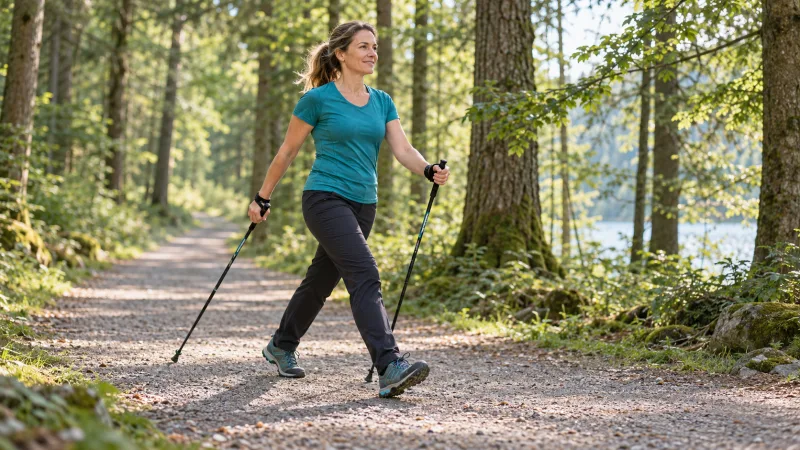
If you like poles, consider nordic walking. It is its own technique, but it also works your upper body and suits longer walks well.
Shoes and clothing for walking
You do not need expensive gear, but shoes matter. Choose athletic shoes with a flexible sole and good heel cushioning that feel comfortable right away. Running shoes or dedicated walking shoes both work well. Save heavy hiking boots for the mountains.
- Size: leave about a thumb's width between your longest toe and the tip of the shoe. Feet swell a little on longer walks.
- Socks: athletic socks without thick seams. Cotton soaks up sweat and causes blisters.
- Clothing: layers. After 10 minutes of brisk walking you will be warmer than you expect.
- Phone: in a waist belt or a zipped pocket, not in your hand, so your arms can swing freely.
In autumn and winter, when it gets dark early, add something reflective. Our post on running in the dark and in winter covers visibility and gear, and most of it applies to walkers too.
Walking instead of running, or walking before running?
Walking does not have to be a stepping stone. For many people it is simply their favorite way to move for years, and that is a complete choice in itself. It is gentler on the joints than running and easier to fit into daily life.
But if after 8 weeks a one-hour brisk walk feels comfortable and you are curious about running, you have a great base. Your tendons, joints and heart are used to regular effort. The natural next step is run/walk intervals, mixing short stretches of running with walking. You will find a ready-made table in our beginner 5K plan: zero to 5 km in 8 weeks.
A few rules for the transition:
- Start with 1 minute of running in the middle of a familiar walk, not with 10 minutes straight away.
- Run slowly. An easy jog may be only a little faster than a very brisk walk, and that is fine.
- Keep your weekend long walk. It keeps building endurance without the load of a long run.
Motivation: walk with others, even from a distance
The hardest part of any plan is weeks 3-5. This is when commitment to other people helps most.
- Fix your times. Tuesday and Thursday after work, Saturday morning.
- Walk with someone. Chatting keeps your pace honest, since that is the talk test in practice.
- Walk "together" from afar. A friend in another city can walk at the same time as you, and afterwards you compare routes and times.
- Log your sessions. Date, time, how you felt on a 1-5 scale. After a month you will see how far you have come.
A few honest notes. Your phone screen has to stay on, because a locked screen or switching to another app can pause GPS and the camera. Streaming with the camera uses a lot of battery and mobile data. On the FREE plan a stream lasts up to 30 minutes, so for a one-hour walk consider sharing the live map without the camera, or check the plans.
If you want your sessions logged automatically, create a free account: activities land in a training calendar, you see your statistics and records, and you can set "150 minutes of walking a week" as a personal goal.
Common walking plan mistakes
Strolling the whole time
A stroll is pleasant, but if you could sing through the entire session, it is not a brisk walk. Check the talk test every few minutes and pick up the pace.
Too much too soon
First-week enthusiasm makes a 90-minute walk tempting. Your feet, calves and shins need time. Blisters and shin pain usually come from adding distance too quickly.
Forcing a longer stride
This is the most common technique error. Speed up with quicker steps and a stronger arm swing, not with ever longer strides.
Quitting after one missed week
Missed a week? Repeat the last week you completed and carry on. Do not "catch up" over one weekend.
After 8 weeks: what next
You have 8 weeks and a one-hour walk behind you. That is a real achievement. You can keep 150-200 minutes a week as a lasting habit, add hilly routes, try nordic walking or take the first step toward running.
Whatever you choose, the main rule stays the same: move at a pace that makes you want to go out again tomorrow.
Frequently asked questions
How fast is brisk walking?
The easiest check is the talk test: during a brisk walk you breathe noticeably faster and can still talk in full sentences, but singing would be hard. For many adults that typically means about 5-6.5 km/h (roughly 3-4 mph), or around 9-12 min/km. Your own pace may differ depending on height, age and fitness, and that is fine.
How many minutes of walking a week is enough?
The World Health Organization recommends that adults get at least 150 minutes of moderate-intensity physical activity per week, and brisk walking counts. That could be 30 minutes on five days or four longer walks. Any extra minute of movement instead of sitting also helps.
Do I really need 10,000 steps a day?
No. 10,000 steps is a popular round target, not a medical rule. It can be motivating, but walking is worthwhile long before you reach it. For training, the minutes you spend at a brisk pace each week and your consistency matter more than a specific number on a step counter.
Can walking replace running?
For many people, yes, as their main form of exercise, especially when starting out, coming back after a break or carrying extra weight. Walking is gentler on the joints, and brisk walking with intervals can be genuinely demanding. If you want to run later, regular walking is excellent preparation.
Let your people follow your route live
Video, GPS map and pace in one link. Viewers need no app and no account.