Safety 9 min read
Running in the Dark and in Winter: Visibility, Layers and a Backup Plan
From November to March most runs start in the dark. Here is how to be seen, stay upright on ice, layer for the temperature and keep your phone alive in the cold.
Published by BEON.RUN · · Updated
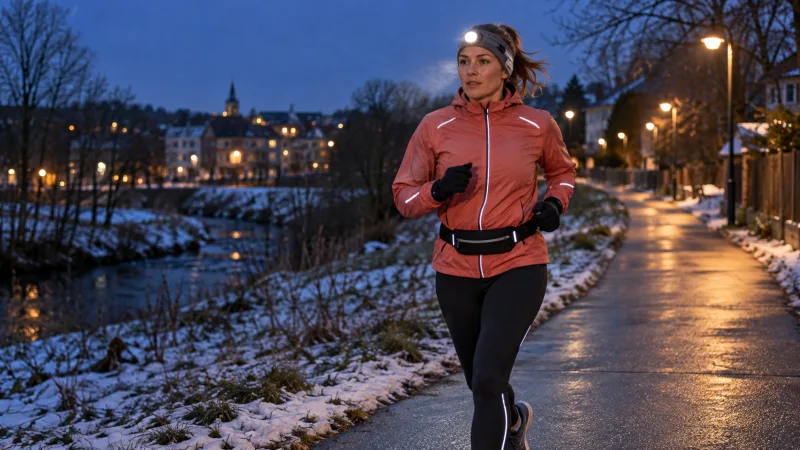
From November to March, most of us run in the dark: before work at 6:30 or after work at 5 pm, when it is already night. Add wet asphalt, leaves on the sidewalk and, in January, black ice. That is not a reason to skip the season. It is a reason to run smarter.
This guide is specific: how to be visible to a driver at 150 meters, what to do about ice, what to wear at -5°C (a full table below), why your phone dies in the cold, and how to set up a simple backup plan so someone at home knows where you are.
Seeing and being seen are two different problems
Most runners buy a headlamp and consider the job done. But a headlamp mainly helps you see potholes and puddles. An oncoming driver sees a single white light that is easy to mistake for a bike or a street lamp. A driver coming from behind does not see it at all.
So think in two categories:
- To see: a headlamp or a chest/waist light. On lit city streets 100-200 lumens is enough; on an unlit path through woods or fields, 300-500 lumens is more comfortable. A light worn low (chest or waist) casts better shadows on roots and curbs than a headlamp.
- To be seen: reflectives and a red rear light. A blinking red light on your back or waist tells a driver clearly: this is a person moving in your direction.
The most important rule for reflectives: put them on what moves. Bands on ankles and wrists move with your stride, and the human eye instantly reads that motion as a person. A reflective logo on your chest is not enough.
A commonly cited rule of thumb: a pedestrian in dark clothes is visible in low beams from only a few dozen meters, while reflective gear can be picked up from around 125-150 meters. At 50 km/h (30 mph), that is the difference between a calm pass and a last-second brake.
Minimum visibility kit
- 2 reflective ankle bands (the cheapest and most effective item),
- a blinking red rear light (clip it to your waistband or pack),
- a headlamp or chest light charged for the full run,
- a bright jacket or vest with reflective stripes,
- one ear free: open-ear headphones or a single earbud.
Surfaces: ice, leaves and snow
Most winter running injuries are not colds, they are falls. A sprained ankle or wrist can take you out of training for 4-6 weeks.
The trickiest spots:
- Wet leaves on sidewalks in October and November: as slick as ice, and they hide holes,
- Bridges, footbridges and overpasses: they freeze before the road because cold air cools them from below,
- Manhole covers, drain grates and painted crosswalk lines: very slippery after rain and in frost,
- Packed snow on city sidewalks, which turns into ice overnight,
- Black ice on morning asphalt: it looks like a merely wet road.
How to run more safely:
- Shorten your stride and raise your cadence. Your foot lands under your center of mass rather than in front of you, which makes balance easier.
- Slow down by 15-30 seconds per kilometer and forget your planned pace. In winter, time on your feet matters more than splits.
- Shoes with deeper lugs, such as trail shoes, grip snow better than smooth road shoes.
- Slip-on traction devices with studs or spikes for ice and packed snow. Take them off on dry pavement, where they lose grip and stress your joints.
- Take corners and downhills carefully, and move intervals to a cleared track or a treadmill.
What to wear for winter running: a table by temperature
The basic rule: dress as if it were about 5-10°C (10-20°F) warmer than the thermometer says. A running body produces a lot of heat. For the first 5 minutes you should feel slightly chilly. If you feel cozy on the doorstep, you will be soaked in sweat by 2 km, and wet clothing in wind chills you fastest.
Three layers: a moisture-wicking base layer (never cotton), an insulating mid layer (thin fleece or a technical top) and a wind-blocking outer layer. Look at the "feels like" temperature, not only the number: a 20 km/h wind can make -2°C feel like about -8°C.
| Feels like | Top | Bottom | Extras |
|---|---|---|---|
| above 10°C (50°F) | T-shirt or thin long sleeve | shorts | cap for rain |
| 5 to 10°C (41-50°F) | technical long sleeve | shorts or light tights | thin gloves optional |
| 0 to 5°C (32-41°F) | long sleeve + vest or light wind jacket | full-length tights | thin gloves, ear band |
| -5 to 0°C (23-32°F) | thermal long sleeve + windproof jacket | tights, ideally thermal | gloves, light beanie, neck gaiter |
| -10 to -5°C (14-23°F) | base layer + thin fleece + windproof jacket | thermal tights | thicker gloves or two pairs, beanie, gaiter over the mouth |
| below -10°C (14°F) | three layers, membrane shell | winter tights + base layer or wind pants | mittens, balaclava or face cover; consider a shorter run or the treadmill |
Hands, ears and face get cold first. Mittens are warmer than gloves, and a thin liner glove underneath lets you use your phone without exposing bare skin to the frost.
Warm up indoors, breathe smart, keep drinking
Warm up inside. 5-8 minutes in the hallway or stairwell: leg swings, hip circles, lunges, high knees, 20 squats. You head out with a raised heart rate and warm muscles instead of standing in the cold stretching for 10 minutes. Still run the first kilometer easy.
Breathe normally, but cover your mouth. Cold, dry air can scratch your throat and trigger coughing, especially at speed. A buff or neck gaiter over your mouth warms and humidifies the air you inhale. Below -10°C, keep your effort at a conversational level. If you have asthma or a heart condition, ask your doctor about running in low temperatures.
Drink even when you are not thirsty. Thirst is weaker in winter, yet you still lose fluid through sweat and the water vapor in your breath. Drink a glass of water before you go and something warm afterwards. On longer runs, a soft flask in a pocket close to your body freezes much later than a bottle on a belt.
Your phone in the cold: why it dies and how to prevent it
This surprises many runners: the phone shows 40%, and after 20 minutes in the frost it suddenly shuts down. Lithium-ion batteries release energy more slowly in the cold, the voltage drops and the system turns the device off to protect it. Manufacturers typically state that phones work best between about 0°C and 35°C (32-95°F).
What helps:
- Keep the phone close to your body: an inner jacket pocket, a running belt under your outer layer or a vest under your jacket. Body heat keeps the battery in a good range.
- Start at 100% and do not charge the phone right after coming in from the frost. Let it warm up first.
- Turn off what you do not need: minimum screen brightness, close background apps.
- Bring a small power bank on long runs and keep it close to your body too.
- Chest mounts and armbands are convenient, but the phone is more exposed to cold and wind. In real frost, a pocket under your jacket is better.
For more, read how to make your phone battery last on long runs with GPS, and our comparison of belts, vests and armbands in how to carry your phone while running.
Choosing your route after dark
In winter, the route matters more than the workout plan. A few rules:
- Lit routes first: parks with street lamps, riverside paths, lit tracks, wide sidewalks along main roads.
- Loops instead of out-and-backs: a 2-3 km loop around your neighborhood means you are never more than a few minutes from home. If freezing rain starts, you simply stop.
- Known routes: do not explore new paths in the dark. Holes and curbs you spot from far away in daylight appear under your foot at night.
- Watch for bikes, e-scooters and cars pulling out of driveways: their drivers often do not expect a runner in the dark.
- Save woods and fields for a weekend daylight run, or run there with a group.
If you are a beginner, winter can be your base-building season. Our zero to 5K in 8 weeks plan works perfectly on short, lit loops.
Backup plan: someone at home should know where you are
After dark and in the cold, a small problem becomes serious fast. A rolled ankle in July means walking home. A rolled ankle at -8°C, 4 km from home on an unlit path, means getting dangerously cold within minutes.
A simple plan before every evening run:
- Tell someone your route and when you will be back. A text is enough: "Park loop, 2 laps, back by 7:15".
- Carry a charged phone, stored close to your body.
- Have a card or cash for a taxi or public transport.
- Agree on a rule: if you have not checked in 30 minutes after your planned time, they call you.
- Share a live link, so nobody has to guess where you are.
For more on running alone, see our guide to safe solo running.
Two honest notes. First, in a mobile browser the screen must stay on: BEON.RUN keeps it awake, but locking the phone or switching to another app can pause GPS. Second, BEON.RUN is not an emergency service. In an emergency, call your local emergency number (112 in Europe, 911 in the US).
Activities are private by default. You can share the link only with the people you choose and hide the first and last 200, 500 or 1000 meters of the route, so your home is not visible on the map.
Checklist before a winter evening run
- Checked the "feels like" temperature and ice warnings
- Clothing picked from the table, slightly chilly at the start
- Reflective ankle bands + red rear light
- Headlamp or chest light charged
- Lugged shoes or traction devices if there is ice
- Phone charged and stored under your jacket
- Lit route, ideally a loop close to home
- Someone at home knows your route and return time and has the live link
- 5-8 minute indoor warm-up done
- Dry shirt and a warm drink waiting for you
Winter does not have to mean a break from running. A few habits do most of the work: reflectives on your ankles, phone close to your body, a lit loop and one person who knows where you are. The rest is just another run.
Frequently asked questions
How cold is too cold to run outside?
There is no single cutoff. A healthy runner in proper layers can run comfortably around -10°C (14°F). Below about -15°C (5°F), in strong wind or on widespread ice, shorten the run, loop close to home or move to a treadmill. If you have asthma or a heart condition, agree on your limits with a doctor.
Is running in cold air bad for your lungs?
For healthy people, cold air usually does not damage the lungs, because it is warmed and humidified in the airways. It can irritate the throat and airways, especially at high intensity. A buff or neck gaiter over the mouth and an easier pace help. Runners with exercise-induced asthma should check with a doctor.
What should I wear running at 0°C (32°F)?
Around freezing, most runners do well with a long-sleeve technical base layer, a light windproof jacket or vest, full-length tights, thin gloves and a headband or light beanie. You should feel slightly cold for the first few minutes. If you feel warm on the doorstep, you will be overheated within 2 km.
Why does my phone shut down in the cold?
Lithium-ion batteries deliver power more slowly when cold, so the voltage drops and the phone may switch off even at 30-40%. The battery usually recovers once it warms up. Carry the phone close to your body under your jacket and start with a full charge.
Let your people follow your route live
Video, GPS map and pace in one link. Viewers need no app and no account.