Races and cheering 8 min read
How to Cheer for a Runner Remotely: 12 Ideas That Actually Help
You don't need a spot on the barrier to make a difference. Here are 12 concrete ways to cheer from afar, before, during and after the race, plus a table of what to say at which kilometer.
Published by BEON.RUN · · Updated
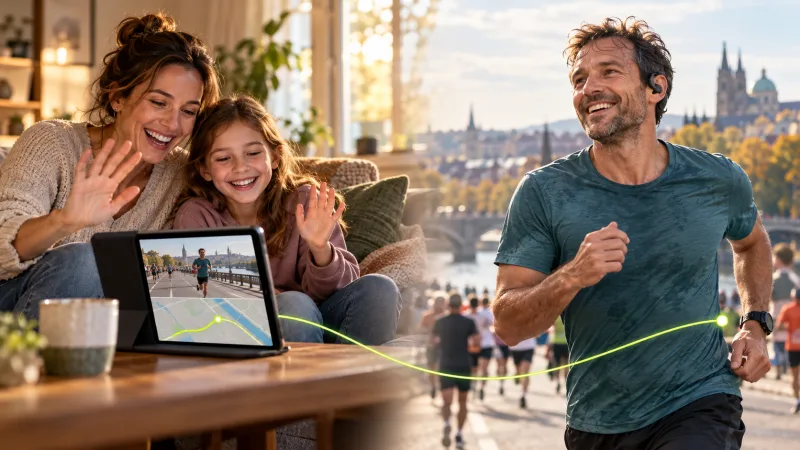
Your friend is standing in the start corral of a marathon, and you're at work, on a train, or three time zones away with a toddler on your lap. It feels like all you can do is cross your fingers. Not true. Well-planned remote cheering can do more at kilometer 32 than a crowd at the barrier, because it's personal and it lands exactly when it's needed.
Below are 12 concrete ideas in three stages: before the start, during the race and after the finish. They work for a marathon, half marathon or ultra, and just as well for a cycling race or a long gravel event. At the end you'll find a table with ready-to-send messages for each stage of the course.
Why encouragement at kilometer 30 matters
The first half of a marathon usually feels surprisingly good. Legs are fresh, crowds are loud and the pace feels easy. The trouble comes later: energy stores run low, muscles ache and the mind starts bargaining. Many runners say that from there on, the race is run more in the head than in the legs.
That's when a short signal that someone is watching and believing changes things. It doesn't add magic energy, but it breaks the "why am I doing this" loop and reminds the runner who and what they're running for. Anyone who has stood on a course knows how runners light up when they hear their own name.
The takeaway is simple: the most valuable support isn't at the start, it's where it gets hard. Everything that follows is about one question: how to deliver the right words at the right kilometer.
Before the start: 4 ideas to prepare the day before
1. A personal playlist for the second half
If your runner listens to music, build them a playlist of songs that mean something to the two of you. Order it so the strongest tracks land around the 2.5-3 hour mark (or whenever their planned pace puts them at 30 km). Your wedding song or that road trip anthem at kilometer 34 beats another generic workout hit.
A practical note: some races discourage or ban headphones. Check the rules, and if they're allowed, bone conduction headphones or a transparency mode keep the runner aware of their surroundings.
2. Notes tucked behind the race bib
Three small notes written in advance, labeled "open at halfway", "open at 30 km" and "open when you want to stop". Hardly anyone does this, and everyone who gets them remembers it. A small zip bag keeps sweat from turning them into pulp.
3. A plan for the hard kilometers
Ask your runner directly: "Where do you expect to struggle?" Most courses have known tough spots, like a long climb, a stretch into the wind or an empty section with no spectators. Write them down and plan to check in right there. If you have the course as a GPX file, it's easy to work out where those spots fall.
4. One agreed channel and one link for everyone
Agree beforehand how you'll follow the race and how you'll send messages. A single link posted in the family group chat the night before saves a lot of stress at 9 a.m. on race day, when grandma asks where she's supposed to watch. We cover the setup step by step in our guide to tracking a runner live.
During the race: 6 ways to cheer from afar
5. Follow the race on a live map
Cheering without information is guesswork. When you can see where the runner is and how fast they're going, you know when the big hill is coming and whether the pace is starting to fade. Every other idea on this list builds on that.
Official race tracking usually shows only split times from timing mats every 5 km. A link from the runner's phone shows their position every few seconds, the route covered so far, distance, time and pace. Between the mats, that's a huge difference.
6. Messages the runner hears in their headphones
This is the most powerful idea here. A runner can't read a chat mid-race, but they can hear it. If messages are read aloud through headphones, your "Sarah, you're at 33 km, we can see you on the map, just 9 km to go, you've got this!" goes straight into their ear at the moment of the crisis.
Write short, write personally and use their name. Don't flood the chat: a few well-timed messages work better than a constant stream that turns into noise.
7. A watch party on the TV
Open the link in your TV's browser or plug in a laptop and turn the race into an event. Map on the big screen, coffee, pancakes, one person on chat duty. Kids love watching the dot that is "Dad" move across the city. It's also a great way for older relatives who aren't comfortable with phones to cheer along with everyone else.
8. A cheering relay: shifts on the hard kilometers
A marathon takes 3-5 hours. Nobody stays fully focused that long, especially at work. Split it into shifts: your brother takes 20-25 km, mom takes 25-30 km, a best friend takes 30-35 km, and the whole group covers the finish. Everyone knows when their stretch is and that it's their job to send one thoughtful message.
The same works for cycling: on a long race or gravel event, split by climbs or by 30-40 km sections.
9. Predict the finish time from the live pace
When you can see current pace and distance, a finish estimate is quick math. Example: the runner has covered 30 km and has been running about 6:00 min/km (around 9:40 per mile) for the last few kilometers. With 12.2 km left, that's roughly 73 minutes. Add it to the current race clock and you know when to expect them at the line.
That estimate is great for the people watching, but don't send it to the runner as pressure. If you want to understand pace and time math properly, read our running pace guide.
10. Share the link in the family group chat
Post the link in the family group or the office channel with a one-line brief: "Running from 9:00, live map here, chat underneath, keep messages short." The more people who know where to look, the more good words land in the right places. With a big crowd, check how many simultaneous viewers the runner's plan allows on the pricing page.
What makes a message actually help
A good mid-race message has four qualities:
- It's short. One or two sentences. Read aloud, it should take a few seconds.
- It's specific. It refers to a place, a kilometer or something you see on the map: "you just crossed the bridge", "the worst hill is behind you".
- It has a name. The runner's and yours. People react to their own name faster than to almost anything else.
- It carries no pressure. No "you must", no "don't let us down", no "you're behind your plan". The runner knows their watch better than you do.
Also skip anything that can break their rhythm: that the pace is dropping, that someone at home is worried, that the projected time is slower than the goal. Save that for the conversation afterward.
Table: what to say at which kilometer of a marathon
| Stage | What's happening | Example message |
|---|---|---|
| Start - 5 km | Excitement, risk of going out too fast | "Easy now, Tom, your race starts after 30 km" |
| 10-15 km | Rhythm, comfort | "Your dot looks so steady, keep it relaxed" |
| Halfway 21 km | First check-in | "Halfway! The whole family is watching, we're so proud" |
| 25-30 km | Fatigue building | "This is where your training kicks in. One step at a time, Anna" |
| 30-35 km | The wall | "Mike, remember all those long runs in the rain? This is what they were for" |
| 35-40 km | Counting every kilometer | "Just one of your Sunday loops left. You've got this" |
| 40-42.2 km | Final push | "We can almost hear the finish! Go, Kate, we're waiting with the medal" |
For a half marathon, shift the last three rows to 15-21 km. For a bike ride, use climbs and feed zones instead of kilometers.
After the finish: 2 ideas to close the day
11. A route screenshot as a keepsake
Screenshot the map with the full route and finish time before everyone forgets. Printed and framed next to the medal, it's a souvenir no race package includes. Save the best chat messages too: the runner usually heard only some of them.
12. A celebration and a recovery meal
Have their favorite food ready when they get home. After a long run, a meal with carbohydrates and protein plus plenty of fluids is a good idea. No diet experiments: what matters most is that it's something they actually crave. Add a short video message from everyone who cheered from afar.
If it was their first marathon, read our first marathon race day guide together. Your cheering plan will be even better next time.
Practical things worth knowing
Tracking from a runner's phone has limits, and it's better to know them in advance:
- The screen has to stay on. In a mobile browser, a locked screen or switching apps can pause camera and GPS. BEON.RUN keeps the screen awake, but the runner shouldn't lock it.
- Battery and data. Streaming with the camera uses a lot of battery and mobile data. For a full marathon, consider map only without video, or carry a power bank.
- Weak signal. Big crowds can overload mobile networks. The stream reconnects automatically after short drops, and GPS points recorded offline are sent when the signal returns, so the route has no gaps. Still, the dot may "freeze" for a moment. Don't panic.
- GPS in cities. Between tall buildings and in tunnels, position can be less accurate.
Remote cheering can also mean peace of mind: the same map you use for race-day support lets loved ones know where someone is during a solo training run. More on that in our article on solo running safety.
You don't need a spot at the barrier for someone to feel you're running with them. A plan, a link and a few well-timed words at kilometer 30 are enough.
Frequently asked questions
What should I text a runner before a marathon?
Keep it short and pressure-free. Remind them of one thing they practiced in training (like starting easy), tell them you're proud of them whatever the clock says, and sign it with your name. Instead of predicting a finish time, say you'll be following live and will check in during the race. Skip anything like you have to break four hours.
How can I track a runner live during a marathon?
Use a tracking link: either the official race app (timing mats every few kilometers) or the runner's own phone sending GPS every few seconds. With BEON.RUN the runner starts an activity in their phone's browser and you open one link showing the live map, pace, distance and optional video, with no account and no app to install.
At which mile of a marathon do runners need encouragement most?
Usually between 30 and 37 km (roughly miles 18-23). That's where fatigue builds fast, pace starts to slip and the finish still feels far away. The second tough spot is the last 2-3 km. One short, personal message in those places is worth more than ten messages in the first hour.
Can a runner hear my messages during the race?
Yes, if they use a tool that reads messages aloud. In BEON.RUN, chat messages from the live page can be read to the runner through headphones using text to speech, so they never need to look at the screen. Keep it to one or two sentences: they are far easier to take in while running.
Let your people follow your route live
Video, GPS map and pace in one link. Viewers need no app and no account.